
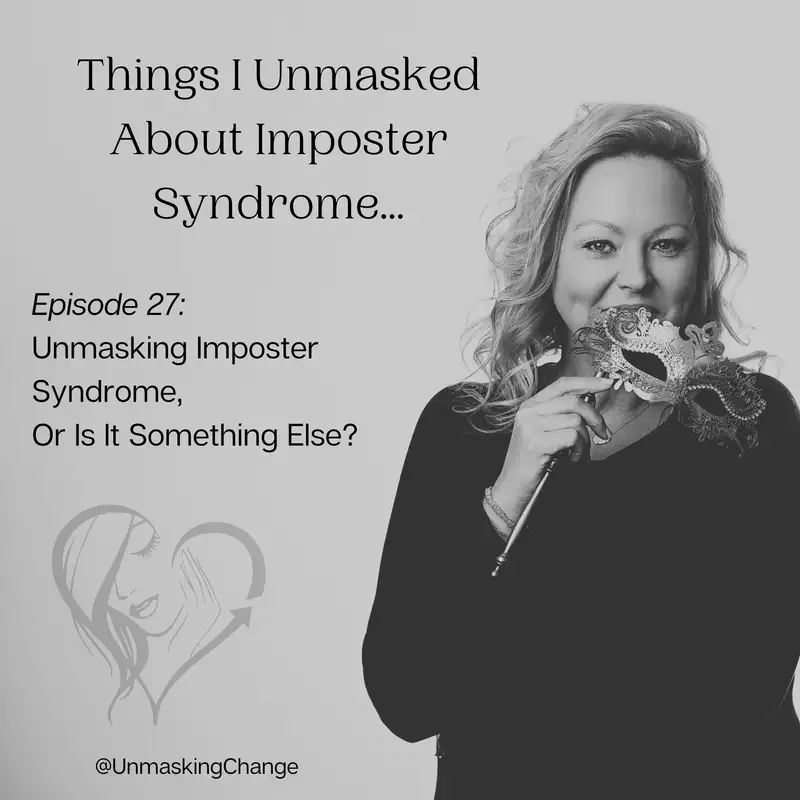
Tammy Winstead (00:00)
Hey friends, and welcome back to Unmasking the Heart for Change.
I'm your host Tammy Winstead and today we're stepping into a conversation that touches so many of us. Imposter syndrome. I want to be honest with you. I'm not here as a therapist or a psychologist or an expert who has mastered it. I'm here as someone who has lived it, studied it and slowly, very slowly at times, started learning how to recognize its patterns in my own life.
And here's what I've come to understand. Sometimes what we call imposter syndrome isn't actually imposter syndrome at all. What if the version of you you've been calling an imposter is actually the real you trying to break away from the mask? What if that discomfort isn't insecurity, but identity? Sometimes what feels like self-doubt
is actually a deep internal knowing of who we're meant to be. And the fear isn't that we're not enough, it's that we finally are. So today I want to gently walk us through what I've learned about imposter syndrome, really, the version of it I personally identify with and what unmasking it has looked like in my own journey.
not as someone who has arrived, but as someone learning right alongside you. All right, friends, let's unmask this one together. Imposter syndrome is often described as the internal voice that insists you're not as capable, talented, or deserving as people believe you are, even when your life offers proof that you actually are. For many of us, imposter syndrome also sounds something like, you're not qualified.
Someone else could do that much better than you. And they're going to wonder how you even got invited here to begin with. And then comes the mask that tells us to smile and hold it all together. Pretend you're confident. Don't let them see you question yourself. You know, the whole fake it till you make it. That's the version most of us talk about. The version tied to perfectionism.
fear of failure and comparison. But the more I peel back my own layers, the more I learn something humbling. There's another version we don't talk about nearly enough. One that doesn't come from thinking you're not enough, but one that comes from finally realizing that you actually are and being terrified to let the world see that version of you.
It's not, I'm not good enough. It's what if I show who I really truly am and it changes everything. And for many of us, that fear runs deeper than we actually realize. This is where my own story becomes less about imposter syndrome and more about unmasking identity. I spent most of my life becoming the version of myself I thought others needed me to be. I was the helpful one.
The strong one, the funny one, the one who holds everything together and the one who softens the room, keeps the peace and makes everyone else feel okay.
When you grow up regulating the emotional needs of others, long before you ever learn how to regulate your own, you learn to build an identity around making people feel comfortable.
You learn to read the room before you learn to read yourself. You learn to disappear in the name of harmony. In that process, you slowly lose track of your own voice. Here's the part nobody tells you. When you finally meet the real version of yourself, the one you were always meant to become, she doesn't feel like an imposter. She actually feels like a stranger you've been searching for your
entire life. For most of my life, I didn't ask myself what I wanted. I followed the paths others laid out because they seemed good, right, logical, or expected. I aligned my dreams with someone else's dreams because that's what good women, good wives, good daughters, or good leaders do. And one day, I woke up with this quiet, unsettling truth rising inside of me. I don't even know who I am.
My kids laugh now about how different their dad and I are, and they joke about how did we ever end up together in the first place? The honest answer, I spent a long time searching for myself. I spent years becoming who people expected instead of who I truly was.
And I never wanted my children to carry that same weight. I wanted them to chase what they want, live the life that lights them up, and follow their own path, not a path laid out by expectations or obligations.
But here's the twist in the story. I took my own children growing up and moving out before I finally gave myself permission to ask, Tammy, what do you actually want in life? What makes you genuinely happy? And what would you choose if no one else's needs were attached to it? And answering those questions was harder than I wanted to admit. Because when you spent your whole life regulating others,
You lose the habit and the muscle of regulating yourself. It's not imposter syndrome, it's identity unmasking. It's finally meeting the version of yourself you were never taught to prioritize. And it's the beginning of the beautiful journey of coming back home to yourself. People often describe me as resilient. And honestly, I am very resilient.
but not because I woke up one day and chose resilience as a personality trait. No. Unfortunately, I became resilient because life demanded it long before I even understood what resilience actually was. When you've walked through hard seasons early in life, when life teaches you to brace yourself before it ever teaches you to rest, tough days don't shock you anymore. You just take a breath and think, well, here we go again.
One of my survival tools has always been humor. Even in the middle of the mess. Even when things hurt, I've always been the person who can crack a joke, lighten the moment, and find a way to make someone else laugh. Even if that someone is me. Like the time I tumbled down the stairs and wrecked my ankle. And there I was, hopping into the ER, making jokes the entire way in. The staff didn't even need to see my face.
They heard my distinct laugh echoing down the hallway and said, Tammy, is that you? There are worse things to be known for in life than a laugh that makes people smile, I guess. But here's the truth I eventually had to face. Even in the laughter, even in the way I bounced back, pushed through, pivoted and chased the next adventure, even in the strength everyone admired and assumed came naturally.
I was still masking. I was still performing. I was still showing the version of myself that felt safe, predictable, light, and easy for everyone else. Because resilience can become a costume just like perfectionism can. Humor can become your armor, and strength can become a mask.
And that's exactly where imposter syndrome sneaks in. Not in the moments when you feel weak, but in the moments when everyone assumes you're strong. In the moments when people applaud your resilience, but never notice your exhaustion. In the moments when you're laughing through pain, you never give yourself permission to feel in the first place. Imposter syndrome isn't always a fear
that you aren't enough, sometimes it's the fear that if you stop being the strong one, the funny one, the put together one, people won't know what to do with the real authentic version of you that lies underneath. Sometimes it's not a confidence issue, it's actually a coping mechanism. Here's the truth. Wearing a mask and experiencing imposter syndrome, they actually go hand in hand.
You can't separate them. One will feed the other. When you've spent years and sometimes decades becoming who others expected you to be, authenticity starts to feel unsafe. Being fully seens feels really risky. And using your real voice feels threatening because you've never heard it ring out without someone else's opinion shaping it. And that's where so many of us get stuck.
Not because we're imposters, but because we're terrified that showing our true selves will disappoint someone, will confuse someone, or disrupt the version of us they're more comfortable with in the first place. We often fear being misunderstood. We fear being too much.
We fear outgrowing the roles we were never assigned in the first place, being the strong one, the fixer, the peacekeeper, the dependable one, even if those roles are actually suffocating us. So we shrink, we soften.
We stay small, we stay agreeable, we stay predictable.
But here's something I've learned and something I want to normalize for all of us. So many people stay stuck because of what someone else said to them or did to them. And those things were never there to carry. Those words, those judgments, those reactions, they are external events completely outside of your control. What is within your control is whether you allow those words to take root
into your identity. Because when you don't allow it to attach itself to your worth, you don't have to heal from something that was never true in the first place. You don't have to unlearn a lie if you never let it become part of your truth. Once I understood this, everything shifted. But here's the question that actually changed everything for me.
Who gets to decide who you are? Whose voice has the authority to narrate your identity? Who told you that you needed permission or approval to become the most authentic version of yourself? We need to normalize this, not the mask, not the imposter feeling.
but the journey back to our authentic selves. The journey of unlearning the roles we played for survival. The journey of healing the parts of us we hid because we were afraid they wouldn't be accepted. The journey of reclaiming our voice, our desires, or our internal compass. Because when we know who we truly are, when we stop performing, when we honor that inner knowing we've ignored for years,
Our mental health shifts, our anxiety softens, our purpose becomes clearer, our confidence becomes real, not forced, and the weight lifts because authenticity doesn't drain us, pretending does. Imposter syndrome often fades not when we learn new skills, but when we finally stop abandoning ourselves.
All right, let's unmask the exact steps I took to break free from imposter syndrome. My hope is that each one becomes a tool you can return to whenever you feel yourself shrinking, doubting, or slipping back into the mask. These steps aren't theoretical. They're actually lived. They're practiced, and they've changed everything for me. Number one, ask yourself, is this imposter syndrome or is this
identity. Most people assume imposter syndrome is always about not feeling good enough, but sometimes the discomfort you're feeling isn't insecurity, it's self-discovery. Sometimes the resilience isn't fear, it's growth trying to happen. And sometimes the voice saying, this doesn't feel right isn't your inner critic, it's your inner self finally speaking up.
Before you label yourself an imposter, pause and ask, is this self doubt or is this a version of me I'm just now meeting? Am I afraid of failing or am I afraid of becoming who I'm truly meant to be? Often, imposter syndrome fades the moment you tell the truth about what really is happening inside of you. Number two.
Stop outsourcing your identity to other people. Now this one was huge for me. You are not responsible for becoming the version of yourself that makes everyone else feel comfortable. You don't owe the world a watered down version of who you truly are. When you outsource your identity, when you let others decide your worth, your direction, your personality, your voice,
You abandon yourself. An abandonment of self always breeds imposter syndrome. Reclaiming your identity means asking yourself what you want, trusting your own decisions, breaking the habit of people pleasing.
recognizing when someone else's expectations are directing your life. You deserve to be the author of your own story, not a character in someone else's script. Yes, I said that. I give you permission to be the author of your own story, not a character in someone else's script. Number three, pay attention to what drains you versus what lights you up.
Your real self leaves clues every single day in your energy, your excitement, your passions, your dread, and your joy. What drained you isn't always meant for you. What lights you up is often leading you. I recently had a situation come into my life where I was considering a new direction. On paper, it checked every box.
But every time I talked about it, something felt dim. And thank God for my honest truth-telling friends. I had a friend call me up and say, Tammy, the light just isn't in your voice anymore when you talk about this. And they were right.
Sometimes, even though things are good, they aren't always meant to be yours. We have to learn the difference. So I've made a rule for myself and it's changed my life. If you come into my life and drain more than you pour back, you don't get to stay. Not because I don't love people, but because I'm finally done sacrificing.
my peace, my joy, my purpose, and my calling to keep spaces full of people who don't reciprocate that same energy back to me. If that new way of thinking makes me selfish, then so be it. It also makes me authentically happy and someone I love waking up to every single day. Now, let me be honest, I welcome everyone, but I no longer allow people to sit at my table
who bring empty hands and full expectations. Boundaries aren't walls. They're doors with intentional access. They're not a weapon. They're not a punishment. They're not a way to push people away. Boundaries are how you honor, protect, and preserve your authentic self. They're how you safeguard your emotional well-being. They're how you stop abandoning yourself
for the comfort of others. Because the truth is, access to me isn't a requirement, it's a privilege. And like any privilege, it comes with responsibility. If someone can't respect my energy, my time, my values, or the version of myself
I'm working hard to grow into, then they don't get a front row access to my life anymore. They can love me from a distance. They can support me from afar. And I'm completely content at peace with that. Protecting your peace isn't selfish. It's self-respect. And it's one of the most powerful steps in breaking free from imposter syndrome and stepping back into your true identity.
Number four, build resilience and rest. This was another hard one for me. This step matters because society glorifies resilience, but rarely honors rest. Yes, resilience is very important, but your worth is not tied to how many hard days you can survive. Being exhausted is not a personality trait.
Being over-functioning is not a badge of honor. Being the strong one shouldn't be your sole identity. Breaking free from imposter syndrome means learning how to rest without guilt. Yes, I'm still learning this one. Stop over-performing. Saying, I need help. Slow down before your body forces you to. And allow softness, creativity, and vulnerability to be a part of your strength.
Strength without rest becomes self-destruction. You deserve both resilience and restoration.
And number five, let yourself evolve without permission. Here's the truth most people are afraid to say out loud. You are allowed to change. You are allowed to grow. You are allowed to pivot. You are allowed to evolve. And you are allowed to outgrow rooms, relationships, roles, and versions of yourself that no longer align with your purpose.
not because you're too much, not because you're inconsistent, not because you're dramatic, but because the room is simply too small for your next chapter. Your evolution isn't a betrayal of who you used to be. It's an act of love toward who you're becoming.
Imposter syndrome loses its power when you finally stop asking the world for permission to be your authentic self. When I look back over my life, I don't think I struggled with imposter syndrome in the way most people describe it. It wasn't that I believed I wasn't good enough.
It was that I had spent years convincing myself to be less than who I truly was. I wasn't pretending to be better. I was pretending to be someone smaller. Repeating words I had heard from others that I was often too much or a lot.
My imposter syndrome didn't stem from overconfidence or pretending to be more qualified than I was. It came from shrinking myself to fit into rooms I had outgrown, masking my real voice to keep the peace, aligning my life with expectations that weren't mine, and silencing the inner knowing that kept whispering, Tammy.
You were made for more. I wasn't an imposter. I was a hidden version of myself waiting patiently, quietly to be unmasked. And maybe, just maybe, you're feeling that too. Maybe the version of you you've been afraid to show isn't an imposter at all. Maybe the voice inside you that keeps asking for more
more alignment, more joy, more authenticity, more purpose, isn't insecurity. It's identity calling you forward. Maybe the person you've been hiding, the one with dreams, desires, opinions, edges, softness, fire, and purpose, is the truest, most powerful version of yourself you've ever known. That's not an imposter. That's your authentic self.
waiting for your moment, waiting for your turn, waiting for you to choose yourself. And the day you stop shrinking, the day you stop apologizing for who you are, the day you decide to unmask. And that, my friend, is the moment imposter syndrome begins to lose its power.
Because here's the truth. Admitting to myself that I deserved more was one of the hardest things I've ever had to unmask. Not because I didn't know it deep down, but because I had spent years convincing myself to settle so everyone else could stay comfortable.
But once I finally told myself the truth, that I was worth more, that I did deserve peace, joy, alignment, and authenticity, I began to realize something else. A lot of people felt that same way too. And maybe so do you. And I say that with all the tenderness in my heart. I know you're carrying roles, expectations, and masks that were never meant to define you.
I know that you've been shrinking yourself to keep the peace, to not disturb the room, to make life easier for the people around you. But friend, you weren't meant to live small. You weren't meant to disappear so others could stay comfortable.
So my hope today truly is that you find the courage to loosen your grip on that mask. Set it down gently and allow the world to finally meet the version of you that has been waiting for years.
your real, unfiltered, unapologetic, authentic self. Because that person is worth knowing, is worth choosing, is worth showing up as every single day. Before we close today, I want to leave you with one powerful question. A question that has the ability to shift your identity, your direction, and the way you see yourself. Who am I when I am no longer performing for the world?
And what would my life look like if I finally chose to live as her? Sit with that. Let it settle and let it rise and let it guide you back to the version of yourself you've been waiting to unmask. Friends, thank you so much for being with me here in this heart to heart conversation today.
If something in this episode stirred you, softened you, or helped you see yourself a little more clearly, I hope you honor that feeling. You deserve a life that feels like you, authentically. You deserve to unmask and step fully into the version of yourself you were always meant to be.
If this episode resonated, send it to someone who might need the reminder that they're not alone in the journey back to themselves.
And if you have a powerful story of growth, purpose, resilience, or unmasking, I'd love to have you as a guest on the podcast. You can apply anytime through the link on our website or in our show notes. Our website is www.unmaskingchange.com. You can sign up there for our unmasking blog.
I'll be sharing deeper journaling prompts, questions, and reflections around imposter syndrome so you can continue to unmask beyond today's episode.
Thank you for listening, for showing up, and for choosing this space. And remember, change begins within, and it starts one heart to heart at a time. Thanks so much for being with me today. I'll see you guys next time. Bye.